Say you are under contract on a one-bedroom in a Mid-Beach tower built in the late 1970s. The building looks fine from the street. The seller's disclosures mention nothing alarming. Your lender pre-approved you weeks ago. Then, sometime after August 3, your loan officer calls with a question you were not expecting: can the association produce its most recent reserve study, and does the master insurance policy carry a deductible above the $50,000-per-unit cap described by Condo Approval?
That question did not exist for most buyers before August 3. According to CNBC, Fannie Mae and Freddie Mac formally retired the Limited Review mortgage pathway on August 3, 2026. The timing could not be worse for a large share of Miami Beach's condo stock. The building's paperwork, not its price tag, now decides whether your financing closes on schedule, closes at a higher rate through a portfolio lender, or does not close at all.
Two Buildings, One Zip Code, Nothing Else in Common
Miami Beach's median condo price sat around $520,000 in early 2026, and resale price per square foot across the neighborhood ranged roughly $1,100 to $1,600 in the first quarter, with branded oceanfront product clearing well above that band. Neither number tells you much on its own. A 1960s studio on West Avenue and a three-bedroom at Faena House can share a zip code, a school district, and a walk score, and have nothing else in common.
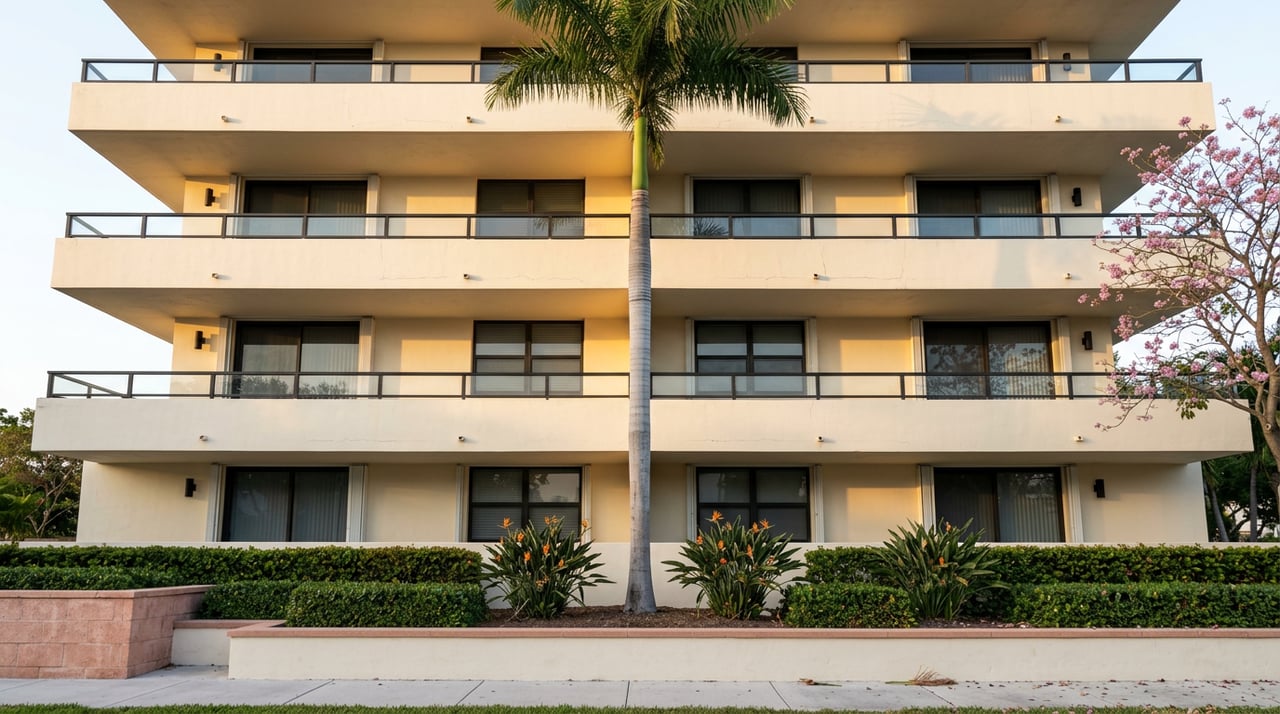
The gap is not about finish level or square footage. It is about what year the certificate of occupancy was issued and whether the association spent the last two decades funding its reserves or deferring the bill. A building like Mosaic at 3801 Collins, completed in 2006, sits in an odd middle position: not old enough to carry the character premium some buyers pay for, not new enough to have been built under the post-Surfside reserve rules that now govern financing. A building like the Flamingo, older and more flexible on rental terms, appeals to a different buyer entirely, one who is trading long-term reserve certainty for short-term income flexibility.
None of that shows up in a median. It only shows up when you pull the individual building's file.
What Florida Already Requires
Two separate rulebooks apply to most Miami Beach condominiums, and they are easy to confuse. Miami-Dade County's building recertification program, in place since 1975, requires structural and electrical recertification once a building turns 30 years old, or 25 if it sits within three miles of the coast, and every ten years after that. The City of Miami Beach administers this locally through its own Building Recertification office.
Florida's newer Milestone Inspection law, passed after the 2021 Champlain Towers South collapse, layers a second requirement on top: condominiums and co-ops three stories or taller must complete a Phase I structural inspection at the same 25- or 30-year threshold, with a more invasive Phase II triggered if the engineer finds distress. Alongside that sits the Structural Integrity Reserve Study, or SIRS, which concerns reserves for major structural components.
Put simply, one law asks whether the building is safe today. The other asks whether the association has set aside enough money to keep it that way. A Miami Beach condo three stories or taller typically has to answer both questions, and the answers are starting to show up as real numbers. Special assessments tied to concrete restoration, waterproofing, and roof replacement in Miami Beach's older coastal towers have landed in the $50,000 to $200,000 per unit range this year.
A building's structural paperwork used to determine your maintenance bill. Since August 3, it also determines whether you can get a loan at all.
The Federal Rule That Landed on Top of It in August
That is the part that changed on August 3. Under the old Limited Review pathway, a buyer with enough equity or a large enough down payment could get a conventional loan without the lender ever examining the condo association's finances. Fannie Mae's Lender Letter LL-2026-03, issued in March and made mandatory on August 3, ends that shortcut for any established project with more than ten units. Every conventional loan now goes through a Full Review of the building itself: its reserve funding, its insurance coverage, its record of deferred maintenance, and any pending or approved special assessments.
A separate provision that took effect July 1 caps the maximum insurance deductible a master policy can carry. As CommunityPay explains, if an association's identified critical repairs exceed $10,000 per unit and the reserve fund cannot cover them, the project can be classified non-warrantable. That classification does not mean the building is unsafe. It means conventional financing through Fannie Mae or Freddie Mac disappears for every unit in it, leaving buyers to rely on cash, portfolio loans, or non-conforming financing, all of which cost more and shrink the pool of people who can bid on your unit if you are the one selling.
Financial press has called it the biggest change to condo underwriting in more than a decade, and the timing lines up almost exactly with the maturing wave of Milestone and SIRS findings across Miami-Dade's older building stock. A structural law written to protect residents and a federal financing rule written to protect lenders are now pointing at the same buildings from two directions.
Vintage vs. Modern, at a Glance
| Pre-1996 vintage tower | Post-2010 modern tower | |
|---|---|---|
| Recertification status | Likely past first 30-year (or 25-year coastal) threshold | Not yet due |
| SIRS / reserve posture | Reserves historically underfunded before 2022 reforms | Built and funded under current code |
| Full Review exposure | Higher risk of documentation gaps or deferred repairs | Generally cleaner Full Review file |
| Typical HOA trajectory | Steeper increases as reserves catch up | Higher baseline, more stable |
| Financing pool if flagged non-warrantable | Cash, portfolio, non-conforming only | Conventional financing intact |
The Documents That Now Decide Your Closing Date
If you are comparing two Miami Beach buildings at similar price points, the conversation with your agent or lender should start well before you write an offer. The documents that matter are:
- The most recent recertification letter or engineer's report, structural and electrical
- The Milestone Inspection report, including whether a Phase II was triggered
- The current Structural Integrity Reserve Study and reserve account balance
- The master insurance policy, specifically the per-unit deductible amount
- A written disclosure of any special assessment that has been approved, levied, or is under board discussion
Ask for these in your initial inquiry, not after you are already under contract. If the documents are not available within a few business days, follow up before drawing conclusions about the building's condition.
What This Means If You're Comparing Buildings
The neighborhood-level median was never a great decision-making tool, but it used to be a harmless one. It no longer is. A low asking price on an older Miami Beach tower can look like value until the Full Review comes back and the building cannot be financed conventionally, at which point the discount reflects a shrunken buyer pool rather than an opportunity. A higher HOA fee on newer construction can look like a cost until you realize it already reflects the reserve funding that older buildings are now scrambling to catch up on.
The useful question is no longer "what does this cost per square foot compared to the neighborhood." It is "what does this building's paperwork say about whether a lender will finance the next buyer the way they financed you." That question has a different answer for nearly every tower on Collins Avenue, and it is the one worth asking before the view does the deciding for you.
Frequently Asked Questions
Does this affect cash buyers too? Not directly at closing, since a cash purchase does not trigger Fannie Mae's project review. It matters later if that buyer ever wants to refinance or if the eventual resale buyer needs a conventional loan, since the building's warrantability status will still apply at that point.
If my building already passed its 40-year recertification, am I in the clear? Recertification confirms the building is structurally sound. It does not automatically confirm the association meets Fannie Mae's separate financial benchmarks for reserves, insurance deductibles, and documented repair funding, which is exactly what a Full Review now checks.
Is a low HOA fee a good sign? Not on its own. A lower monthly fee in an older building can mean healthy finances, or it can mean reserves were kept artificially low for years and the gap is about to surface as a special assessment or a financing denial. The reserve schedule tells you which one you are looking at.
Comparing buildings on this level takes local knowledge of which towers have already cleared their Milestone and SIRS obligations and which are still working through them. That is the conversation we have with buyers and sellers across Miami Beach every week. If you are weighing a purchase or preparing to list in one of these buildings, the Juliana Savoia Group can walk through the specific documents your building or your target address will need before a lender ever sees the file. Request a Private Consultation to start that review.
This article is general information, not legal, tax or financial advice. Consult a qualified professional about your situation.